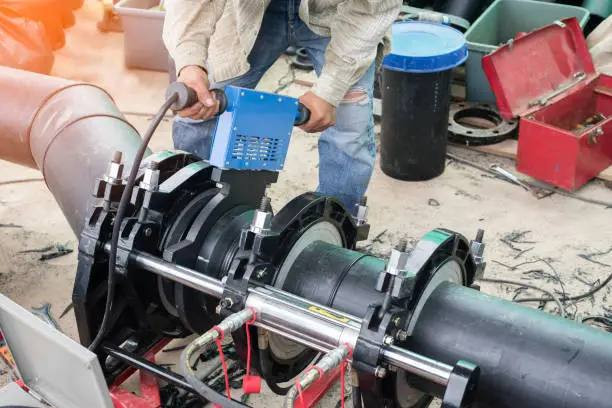
Polyethylene Pipe Connections and Welding Methods
Polyethylene pipes, due to their lightweight, high chemical resistance, flexibility, and long lifespan, have become a suitable replacement for metal and concrete pipes in water supply, gas distribution, sewage systems, agriculture, and industrial networks. One of their key advantages is the ability to form secure, leak-free connections through various welding techniques. Unlike metal pipes, which are typically joined using mechanical or threaded fittings, polyethylene pipes are fused homogeneously (at the molecular level), creating a unified and durable structure.
Types of Polyethylene Pipe Welding Methods
1. Butt Fusion Welding
This is the most common and widely used method for joining polyethylene pipes. In this technique, the ends of the pipes or fittings are first planed and aligned using a facing tool. Then, heating plates at approximately 200–220°C melt the surfaces. After removing the heater, the melted ends are pressed together to form a uniform and strong joint.
2. Electrofusion Welding
This method uses special couplers or fittings equipped with embedded metal coils. When electric current passes through the coils, heat is generated, melting the inner surface of the fitting and the outer surface of the pipe. Once cooled, a strong and leak-proof connection is formed. Its advantage lies in not requiring bulky equipment, making it ideal for confined spaces or quick repairs. It is commonly used in gas distribution systems and high-sensitivity piping.
3. Extrusion Welding
Primarily used in industrial projects and the construction of large polyethylene components. In this method, polyethylene rods or granules are melted by an extruder and injected as filler material between two parts. It is mainly applied in joining sheets and building polyethylene structures such as tanks and channels.
4. Socket Fusion Welding
Suitable for pipes and fittings with smaller diameters (typically under 110 mm). The pipe end and the inside of the fitting (socket) are heated using a thermal mold. The pipe is then inserted into the fitting, and after cooling, a seamless weld is formed.
5. Mechanical Methods (Threaded or Flanged Connections)
In specific cases where welding is not feasible, threaded or flanged fittings can be used. Although this method lacks the permanent strength and sealing of welded joints, it is essential for connections that need to be opened or closed, such as those to valves or pumps.
Conclusion
Choosing the appropriate method for connecting polyethylene pipes depends on factors such as pipe diameter, operating pressure, environmental conditions, fluid type, and equipment availability. Applying the right welding technique ensures long service life and safe performance of the piping network. In general:
-
For large diameters and main projects: Butt Fusion Welding
-
For sensitive systems and confined spaces: Electrofusion Welding
-
For small pipes: Socket Fusion Welding
-
For tanks and sheets: Extrusion Welding
-
For special connections: Threaded or Flanged Fittings